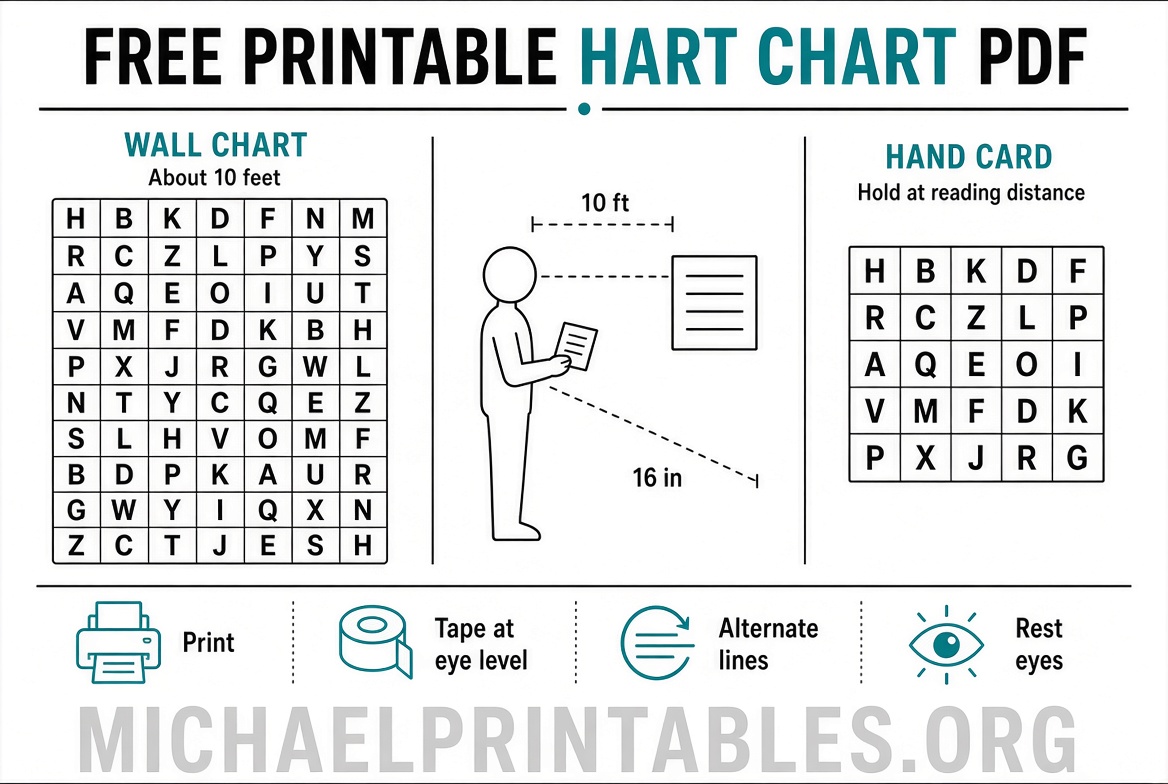
Free Printable Hart Chart PDF Download Guide – A free printable Hart Chart PDF is a letter or number grid used for near-far focusing practice. Clinics print a large copy for the wall and a small copy to hold at reading distance. The goal is accommodative facility: clearing the print quickly when you look from far to near and back.
This page lists legitimate free charts you can download, plus a simple setup for US Letter paper. It is a resource guide, not a treatment plan. If an optometrist, orthoptist, or vision therapist gave you a schedule, follow that plan.
What a Hart Chart Is?
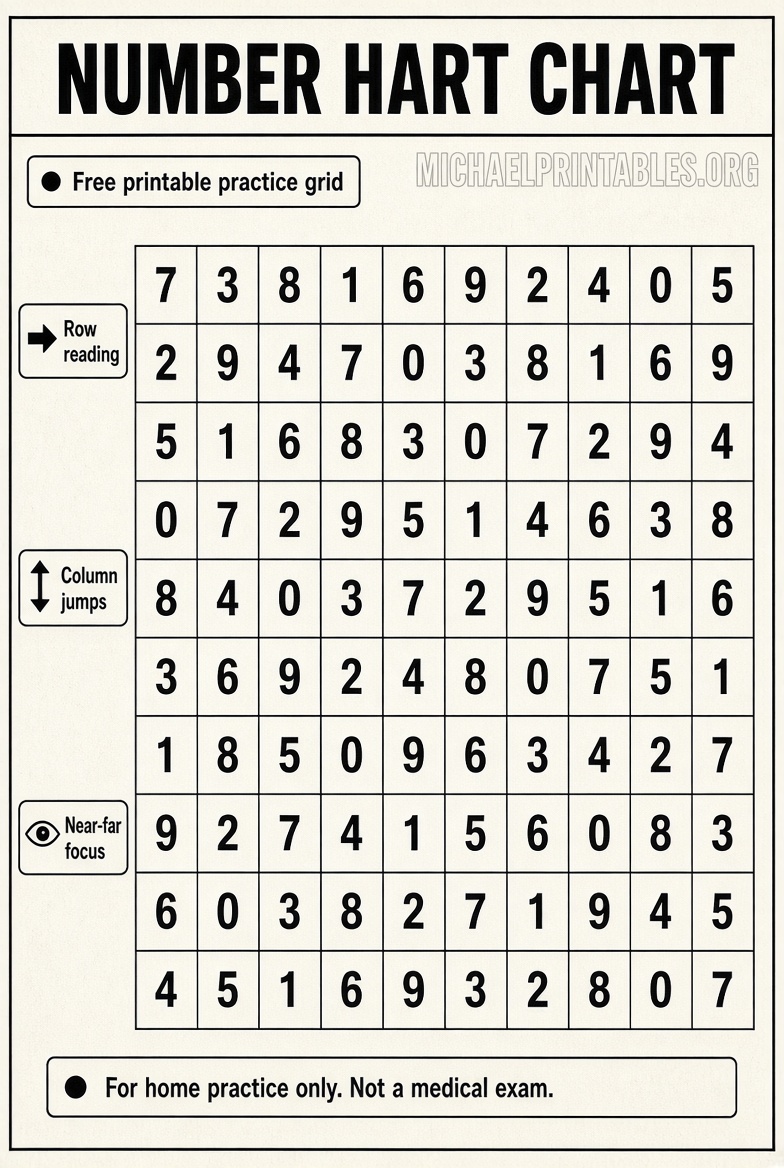
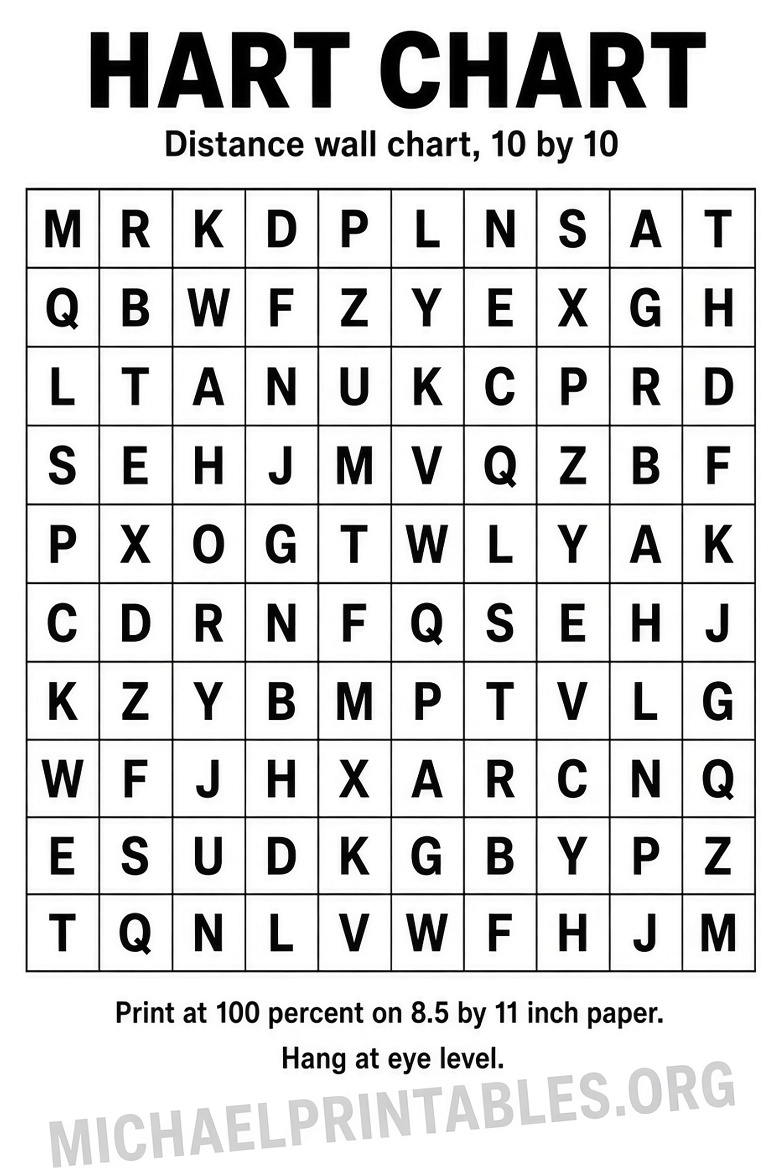
A Hart Chart is usually a square grid of random letters or numbers, often about 10 rows by 10 columns. The characters are mixed so you cannot memorize the page. Each symbol has to be found, focused, and read before the eyes move on.
The same sheet can be used in more than one way. Row reading practices tracking. Column jumping practices saccades, the quick jumps between targets. The classic near-far Hart Chart practices focus change. A large chart goes on the wall. A small chart stays in the hand.
The Bedfordshire and Luton Children’s Community Eye Service describes it as an accommodation exercise. Slow focusing can make print blur when you look up from a book or screen, and close work can become uncomfortable. Their handout was last reviewed on November 1, 2024.
Who a Free Printable Hart Chart Helps?
Home users usually want a Hart Chart PDF for one of these reasons:
- A clinic assigned near-far rock or accommodative facility work.
- Reading feels slow to clear after looking across the room.
- A therapist wants a simple saccade or scanning sheet.
- A teacher or occupational therapist needs a black-and-white grid on 8.5 by 11 inch paper.
A free chart does not diagnose convergence insufficiency, lazy eye, or a vestibular problem. Stop and check with your eye doctor if you get double vision, strong headache, dizziness, or nausea.
Free Printable Hart Chart PDF Download Guide
Where to Download a Legitimate Free Chart?
Skip random worksheet sites that hide the file behind a popup. These sources actually host a chart or a free download page.
Hospital eye-service charts. The Bedfordshire and Luton Children’s Community Eye Service posts free Hart Chart files and instructions: Hart chart handout and downloads. The files are Word documents, not PDFs: letter sets labeled ADS, AFJ, and QEU, plus a numbers chart. Open one, then use Print and choose “Microsoft Print to PDF” or “Save as PDF” if you need a PDF. Print the large chart, cut out the small chart, and tape the large one at eye level.
Public PDF folder. A public Google Drive folder of vision-therapy sheets includes Hart Chart.pdf and Tumbling E Hart Chart.pdf: Vision Therapy Public PDFs. Open the folder, click the Hart Chart PDF, and use the Drive download button. No payment is required. The tumbling-E file is useful if the reader is still learning letters.
Free US Letter packet. A pediatric occupational therapist lists a 22-page Hart Chart clinic set at $0 on Teachers Pay Teachers: Hart Charts oculomotor packet. It is sized for 8.5 by 11 inch paper and includes letter charts, number charts, mixed charts, and pocket cards for near-far work. A free Teachers Pay Teachers account is normally required before the PDF downloads. The license is single-classroom or single-therapist use.
Wall-chart PDF page. Optometry Skills hosts a Hart Chart eye-exercise page with a PDF download for the wall copy and an on-screen chart for near: Hart Chart eye exercise. The page suggests printing at A4 and hanging the sheet about 10 feet away. On US Letter paper, scale to fit and leave a small margin.
Paid clinic sets from suppliers such as Bernell are a different product. Do not treat a product page as a free printable unless the price is zero.
How to Print the Hart Chart PDF?
Use these settings for a clean free printable Hart Chart PDF at home:
- Paper: US Letter, 8.5 by 11 inches.
- Color: black and white is enough.
- Scale: 100 percent, or “fit to page” only if the edges are cut off.
- Stock: ordinary paper works. Cardstock keeps the near chart from bending.
- Copies: one large wall chart and one small handheld chart. If the file has only one size, print a second copy and cut the grid down.
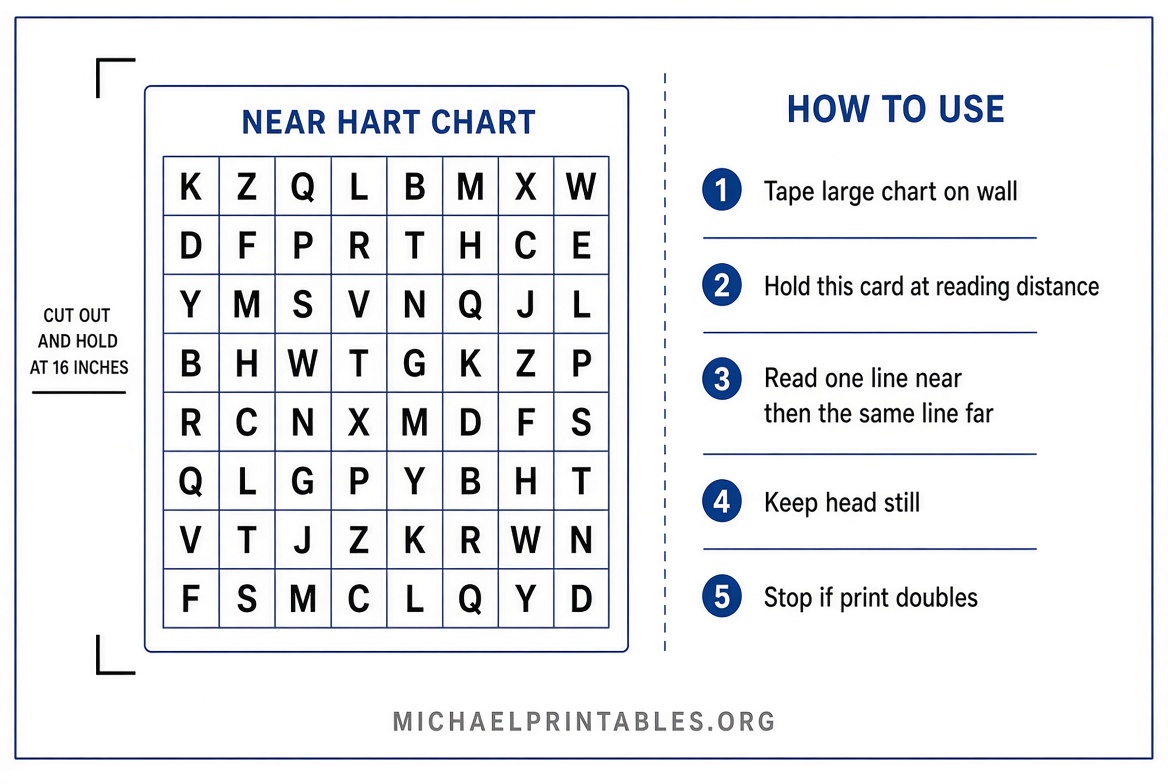
Hang the large chart at eye height in good light. Many clinic sheets use about 10 feet (3 meters). The hospital handout says to place it far enough that the letters are only just readable. Hold the small chart at your usual reading distance, about 16 inches (40 cm).
Both charts should stay in view without a head turn. When the far chart is clear, the near chart should look soft, and the reverse. If both look the same, the distance gap is too small.
How to Do the Near-Far Hart Chart?
A typical session looks like this. Your clinician’s version wins if it differs.
- Cover one eye if you were told to work monocularly. Otherwise use both eyes.
- Read the first line, or the first few letters, on the near chart. Wait until they are clear and single.
- Look to the same line on the wall chart. Read it only after it clears.
- Continue line by line to the bottom.
- Rest by closing your eyes or looking out a window.
- Repeat with the other eye if you are patching.
Innovative Eye Care’s patient sheet uses one letter at a time, five rounds, three times a day, then moves the near chart closer only after the longer distance is easy. Optometry Skills suggests 3 to 5 full cycles, twice a day in an acute phase and once a day for maintenance. The hospital sheet starts with five letters at a time and says an orthoptist may drop that to three or one letter to make it harder.
Keep the head still. Blurry guessing does not count. Clarity before the next letter is the point.
Other Drills on the Same Sheet
A Vision and Learning Center write-up explains three uses of one grid: Vision therapy activity: Hart Chart.
- Row reading: read across each line, as you would a book.
- Column jumping: bounce between two columns, outside pair first or center pair first.
- Near-far rock: alternate the handheld chart and the wall chart.
Saccade strips and column charts in the same Drive folder are a separate drill. They are not a substitute for the near-far chart if focus change is the assigned goal.
Safety Notes Before You Start
Wear your current distance glasses if you use them for the wall chart. Do not add a homemade prism or colored overlay unless it was prescribed.
Keep early sessions short. Fatigue, a headache, or double print is a reason to stop, not to push through. Children should do this with an adult watching for squinting, head tilting, or loss of place.
Free files are for personal or assigned home practice. Clinic packs often limit copying to one classroom or one therapist. Check the license before you hand the PDF to a whole school.
FAQ
Is there a truly free Hart Chart PDF?
Yes. The public Drive folder includes Hart Chart.pdf and Tumbling E Hart Chart.pdf. The hospital page offers free Word charts you can print or save as PDF. The Teachers Pay Teachers packet is listed at $0 in US Letter size.
What size should I print?
US Letter, 8.5 by 11 inches, is the right default in the United States. A4 files still work if you scale to fit.
How far away does the wall chart go?
Common clinic distances are about 6 to 10 feet, with the near chart at about 16 inches. Use the distance where the far letters are just clear and the near chart blurs when you look far.
Can I use a screen instead of paper?
Yes for the near chart. Keep the screen about 16 inches away and the printed chart on the wall. Paper is easier to tape at eye level and does not depend on brightness settings.
Does a Hart Chart replace an eye exam?
No. It is a practice sheet. Blur, double vision, or headaches need an eye-care evaluation before you build a home routine around a free printable.